
CHARLEY
Our last post by Charley was something else! It blows my mind how much she has grown. Her insights and experiences are her own, and that post was 98% her own writing — I just helped with a little grammar and flow. Thanks for your comments; we all appreciate them and feel the same way. I’m not sure this next entry will be quite as exciting, sorry!
24 – 29 June
Leaving the lovely coolness of Jericó, we began our descent from the mountains, heading towards Medellín and into the humid heat of the lowlands. We explored the immediate area, where chaos seemed to reign. Market stalls stretched as far as we dared to walk, packed with people wearing yellow Colombian World Cup football jerseys. With no free Wi-Fi, we decided to head over to a big, modern outdoor shopping mall, where we picked up some new clothes for Charley before finally deciding it was time to head back up to camp.
By then, it was around 9 p.m., and rather than attempt the complicated journey home by public transport, we ordered an Uber. That ended up being an expensive day of transportation, costing us more than $120 CAD. Medellín may have an excellent public transportation system, but getting a family of four up and down the mountains certainly isn’t cheap when you rely on taxis and Ubers!
The following day, we decided to try the public transport system instead. Our campground was about a 45-minute bus ride up into the hills above the city, so we caught the bus down to Medellín and then used the subway to get around.
CITY GONDOLA
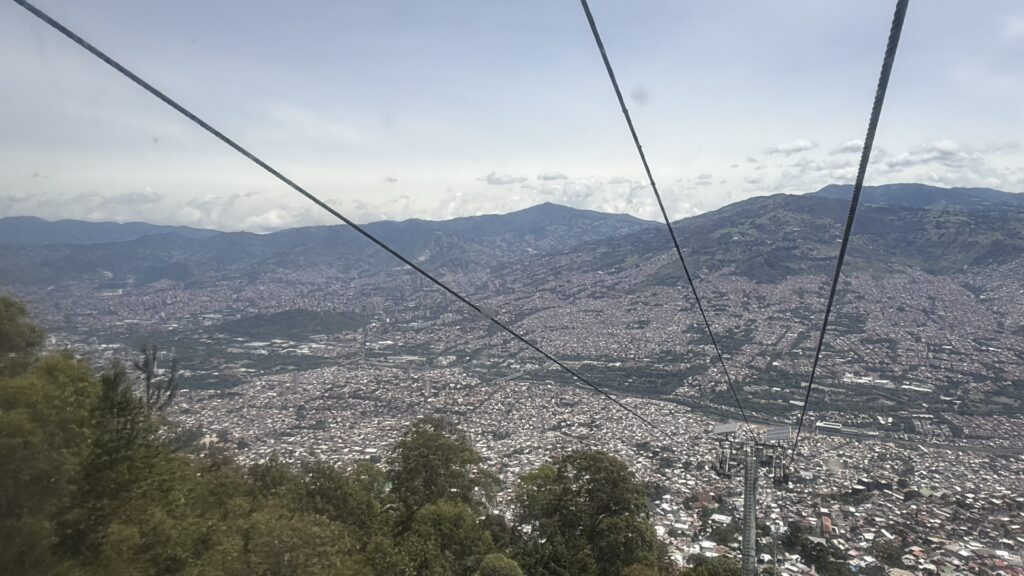
From above, Medellín spreads out in every direction. The city seems to go on forever — an enormous ocean of orange-brick buildings packed tightly across the mountainsides. House after house, wall to wall, with corrugated metal roofs. The mountains are covered in homes, roads and people, and below us the city was a chaotic swirl of cars, buses and motorbikes.




We explored the immediate area, it was chaotic, market stalls stretching as far as we dared to walk, packed with people wearing yellow Colombian World Cup football jerseys. With no free wifi we decided to head over to a big & modern outdoor shopping mall where we picked up some new clothes for Charley before finally deciding it was time to head back up to camp. By then it was around 9pm, and rather than attempt the complicated journey home by public transport, we ordered an Uber. That ended up being an expensive day for transport, costing us more than $120 CAD. Medellín may have an excellent public transportation system, but getting a family of four up and down the mountains certainly isn’t cheap when you rely on taxis and Ubers!
The following day, we decided to try the public transport system instead. Our campground was about a 45-minute bus ride up into the hills above the city, so we caught the bus down to Medellín and then used the subway to get around.
PARQUE EXPLORA
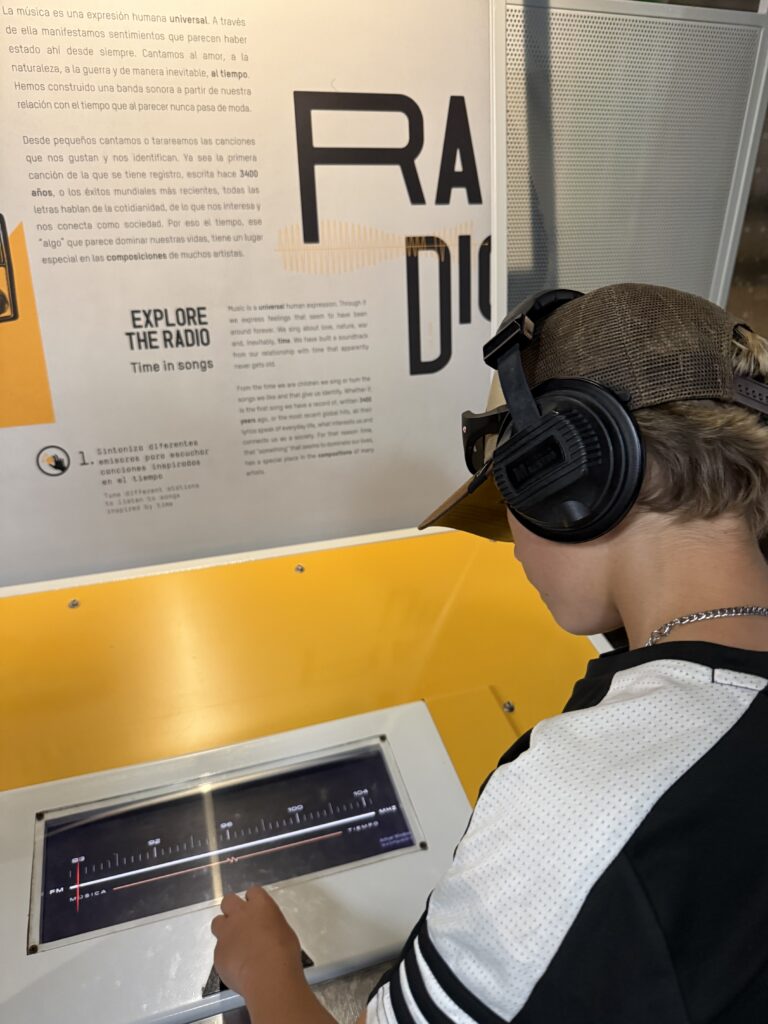
Our first stop was Parque Explora, Medellín’s huge interactive science museum. It is a place like Science World in Vancouver and the SESI LAB in Brasília, Brazil, which we had visited earlier, where science is designed to be played with rather than simply looked at. We spent most of the afternoon experimenting with concepts involving time, space, sound and music. There were interactive exhibits everywhere — things to touch, move, listen to and experiment with. We played with light and sound, explored the way music works and experimented with the strange ways our brains perceive the world. It was exactly the kind of museum where you can easily lose track of time, and we all had a great afternoon.
I hadn’t realized our kids didn’t know how to tune a radio station using a dial. They had absolutely no idea that you used to slowly turn a knob through a sea of static, hoping to land on the right station. Apparently, this is now ancient technology. Really, was it that long ago? Now I’m feeling old. Next thing I know, I’ll be explaining what a VCR was.




The public bus back up the mountain was an experience in itself. The driver seemed to believe he was auditioning for lead driver in The Fast and the Furious, hurtling around tight corners, accelerating hard and braking late. The bus rattled and bounced its way up the mountain, and I spent a good portion of the journey wondering whether the driver knew just how close we were to the edge of the road, while the passengers didn’t blink an eye!
We survived!!
Our third day in Medellín was spent partly with our Czech friends and partly exploring more of the city’s difficult and complicated history. Back down on the derby bus, our 45min white knuckle, rollercoaster ride dropped us outside the lovely flower market this time.
CASA DE LA MEMORIA
We visited the Museum, Casa de la Memoria, the House of Memory, which tells the story of Medellín’s long history of violence, conflict and loss. The museum focuses on the experiences of the people who lived through Colombia’s years of armed conflict, drug cartels and violence, giving a voice to the victims and families who were left behind.
It is not an easy place to visit, but it is an important one. Medellín’s history is deeply connected to the era of the cartels, particularly the years when the city became internationally synonymous with Pablo Escobar and the drug trade. The museum moves beyond the famous names and headlines to tell the stories of ordinary people — families who lost loved ones, people who were displaced from their homes and communities that were torn apart by violence.
After snapping a few photos I was reminded that photography wasn’t permitted. oopsy.


PLAZA BOTERO
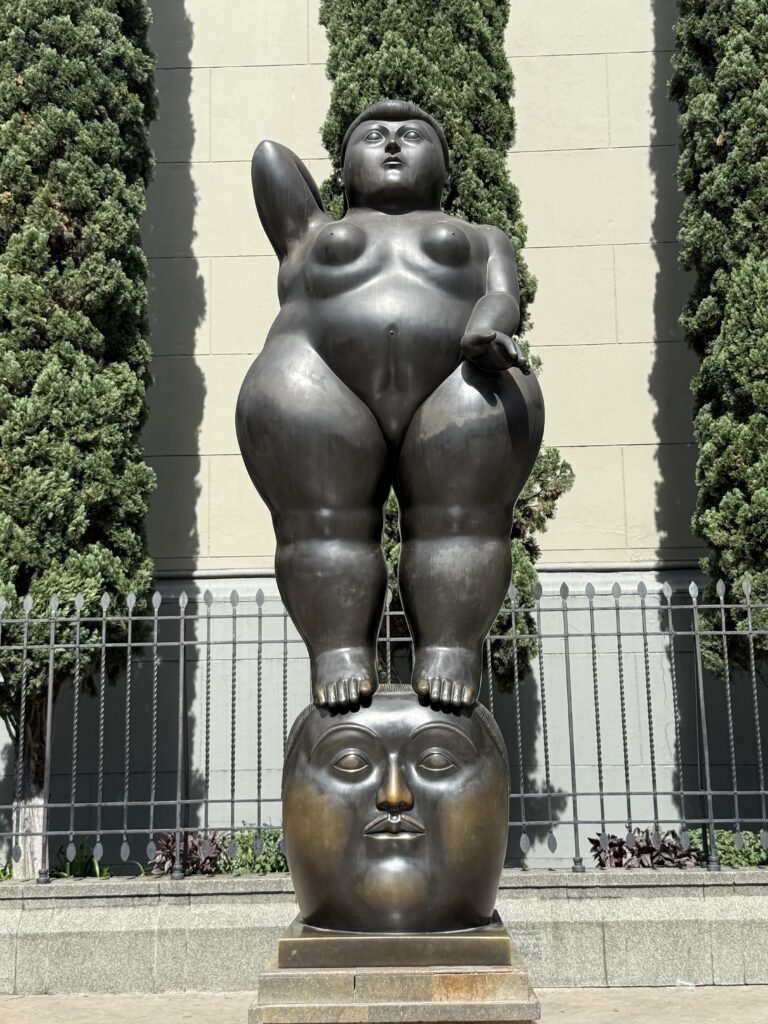
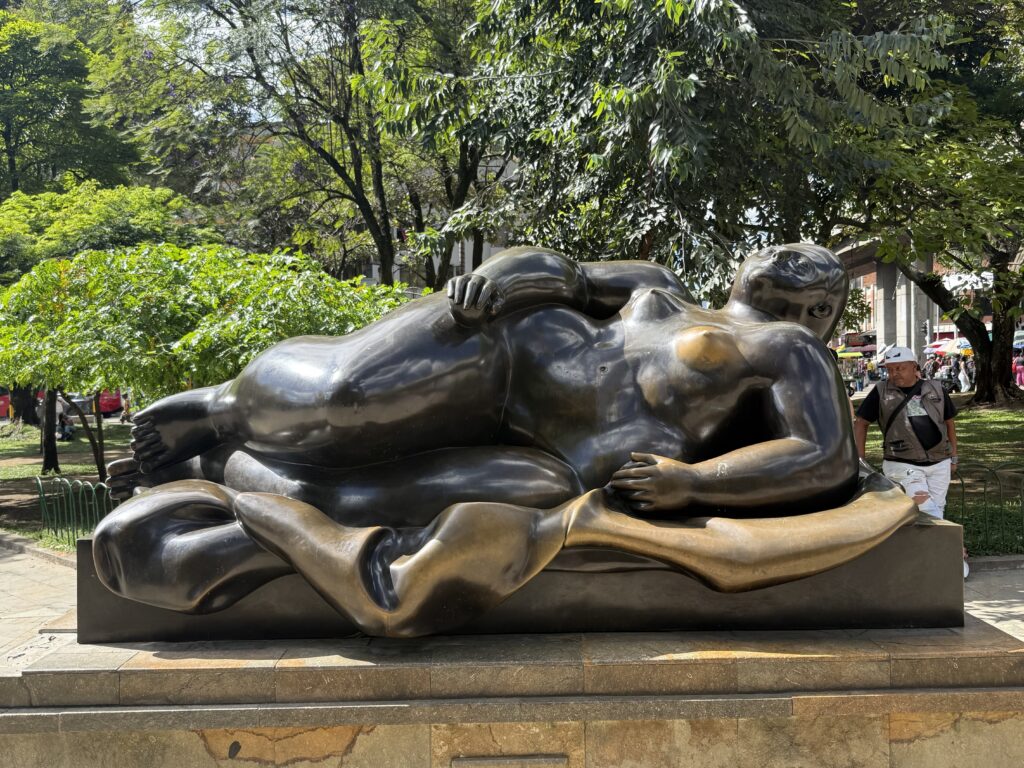
From there, we walked down towards Plaza Botero, the famous open-air square filled with enormous bronze sculptures by Colombian artist Fernando Botero. His distinctive style is instantly recognizable, with people and animals portrayed in exaggerated, wonderfully rounded forms. The sculptures are fun, quirky and impossible to miss — and, apparently, impossible not to touch. Although I suspect Botero would have preferred us to admire the art rather than polish it with our hands.
Sadly, on a Saturday afternoon, the plaza was heaving with people. We weren’t really enjoying the chaos, so after admiring the sculptures, we moved on.




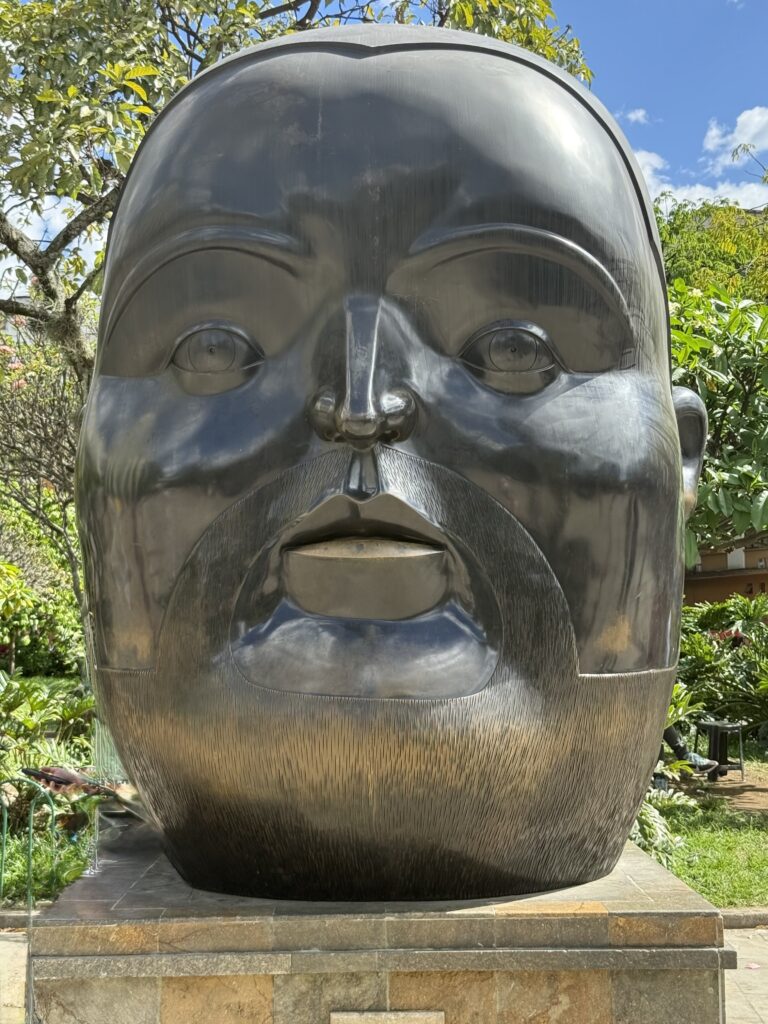


We then visited the Museum of Modern Art. It wasn’t quite what we had expected, but that didn’t stop us from enjoying it. Sometimes the museums you don’t quite understand are the ones that give you the most to talk about afterwards!
That evening was game night: Colombia versus Portugal. This explained why the city had been so full of people wearing yellow jerseys. Colombia was playing in the World Cup, and the entire city seemed to be alive with energy. Everywhere we looked, people were wearing Colombia jerseys. The streets were pulsing with excitement, and the whole country seemed to be united behind its team.
Not wanting to get stranded in the city, we decided to catch a bus home around 8 p.m. As it turned out, we just made it. The bus we caught ended up being the last one heading up the mountain, leaving at around 9 p.m., and we were very lucky to get home.
MIKE-DAD-GRANDPA
But by the following day, our hearts were heavy.
We are a very long way from home, and Mike, who is 89 and living with advanced Parkinson’s disease, had been taken to hospital. We were desperately worried. We were also in a difficult position, with our shipping date approaching and our truck booked to leave soon. Flying home was not really possible, and we were faced with an incredibly tough decision.
Travel is not always about beautiful places and exciting adventures. Sometimes it is about being far away when you desperately want to be close to home.
We sent big hugs, letters of love and prayers for recovery to Dad and Karen.
There was no desire to go sightseeing that day. Instead, we stayed at the campground and tackled some of the less exciting but necessary jobs of life on the road — laundry, truck maintenance and trying to keep everything moving while our minds were somewhere else entirely.