
I realize that once more I’m writing after the fact. So much has happened in these past few weeks, there’s been not time or energy to write. So I’ll continue to play catch up. Thanks to you all for taking the time to read our posts and follow along on our journey. Hearing your comments always means a great deal to us all. so rewinding a little to the end of last month… I wrote in the present tense.
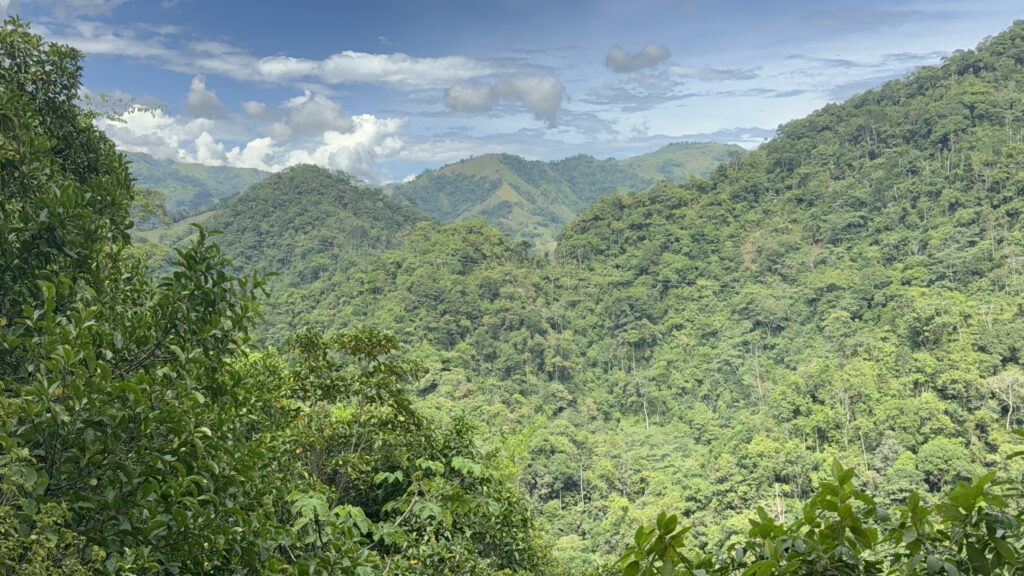
30 June – 6 July. Leaving the comfortably cool hills above Medellín, we spent the morning winding our way down into Colombia’s lush, humid lowlands. The landscape changed almost by the kilometre. Pine-covered hills gave way to dense jungle, the temperature climbed steadily, windows wide open, our only cooling was forward movement, in this region the air is still.
Travelling through Colombia has taught us one thing above all else—never trust the map.
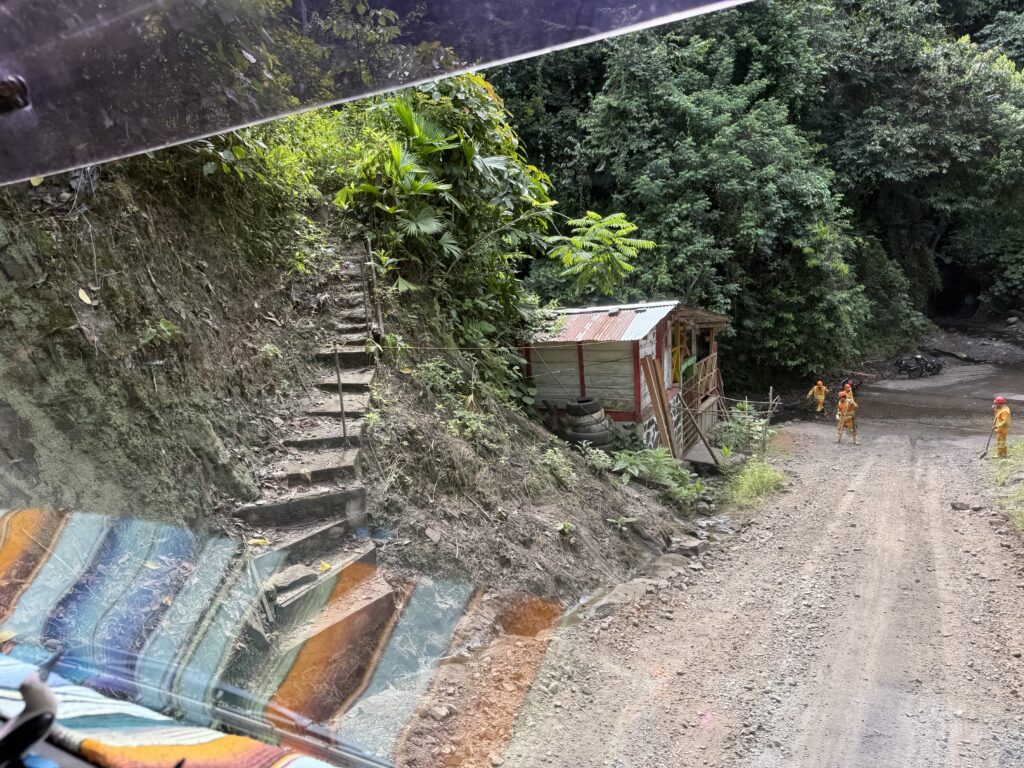
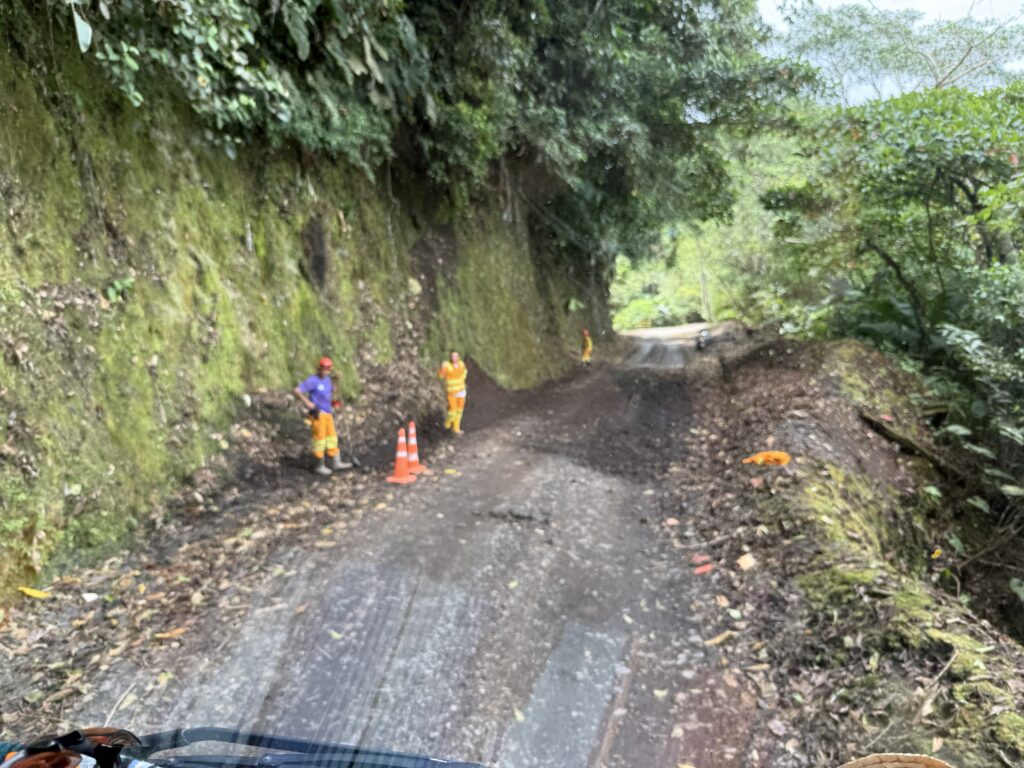
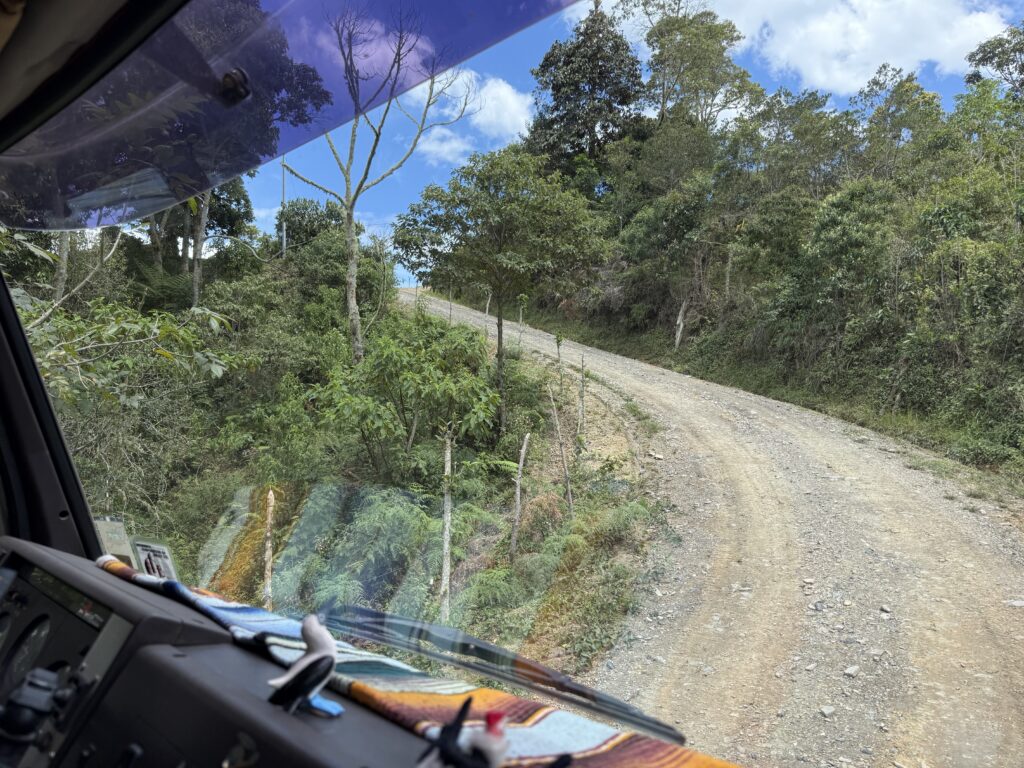
Those thick yellow lines that promise “main roads” often turn out to be little more than rough dirt tracks, twisting endlessly over steep mountainsides. Distances that look easy on paper become full days behind the wheel. Once more progress is measured in hours rather than kilometres.
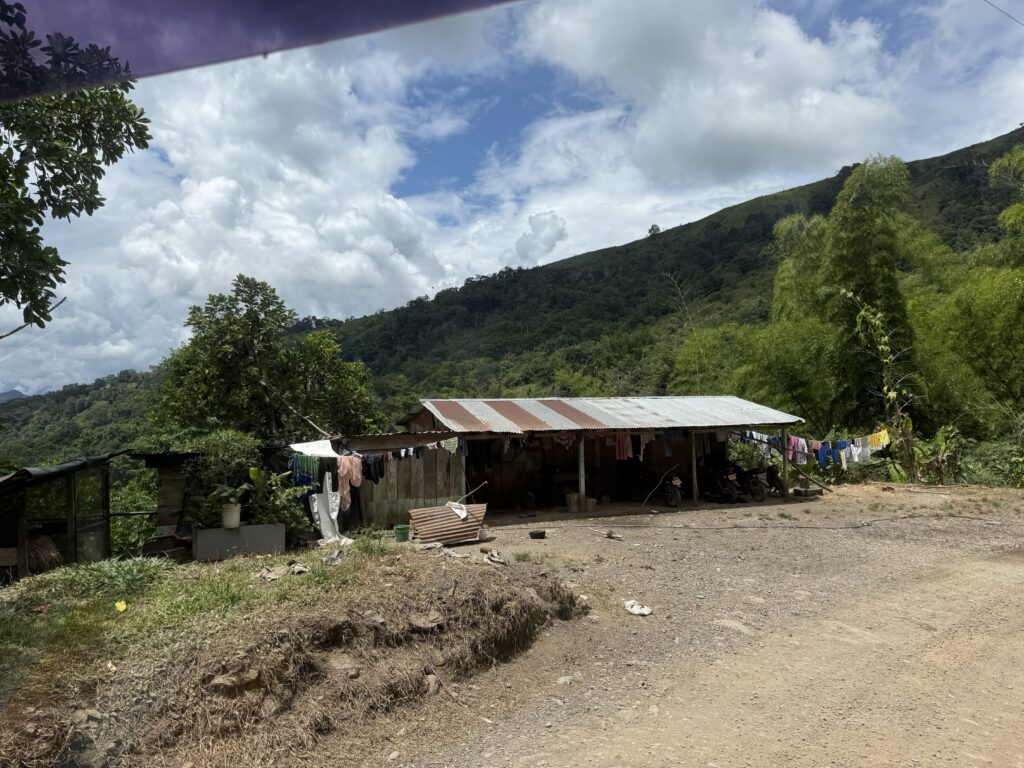
With a little time still up our sleeves before needing to be in Cartagena, we decided to head for the small mountain town of Florián. Our original route was closed by a landslide, sending us onto even smaller back roads where every road seemed to be dirt, steep and rough. It took us three days to cover what looked like a simple detour, on small dirt tracks that connected farms and remote communities. The locals certainly gave us a weird look as we slowly rolled by.
It was worth every bump.
A NOT SO HAPPY CANADA DAY
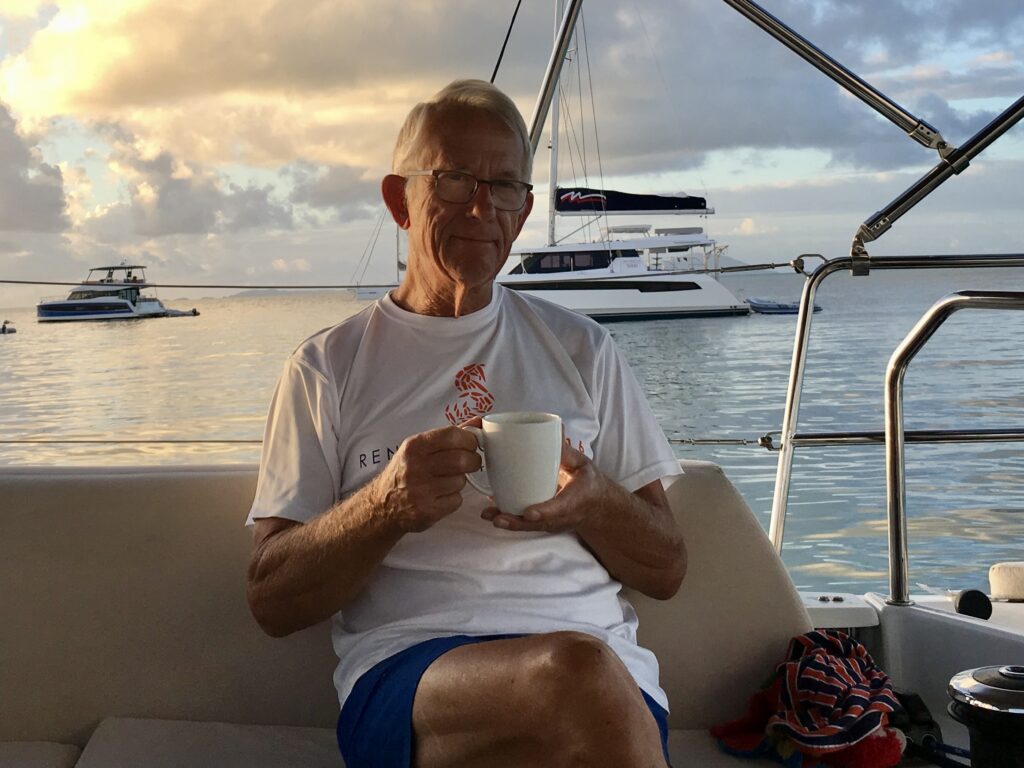
1 JULY. It’s been a difficult few days as we’ve watched Dad’s condition deteriorate from the other side of the world. After developing pneumonia and further complications, Mike slipped away peacefully in the early hours of Canada Day. He was a truly wonderful man who lived a long, full and interesting life, accomplishing so much along the way. Our hearts are broken, and we’ll miss him dearly.
Karen, we’re so incredibly sorry we couldn’t be there with you. Sending you the biggest hugs from Colombia.
Carrying Mike with us in our hearts, we continued deeper into the Colombian mountains…
FLORIÁN
Pushing forwards and holding Mike in our hearts we venture on, deeper into the hills, miles from anywhere.
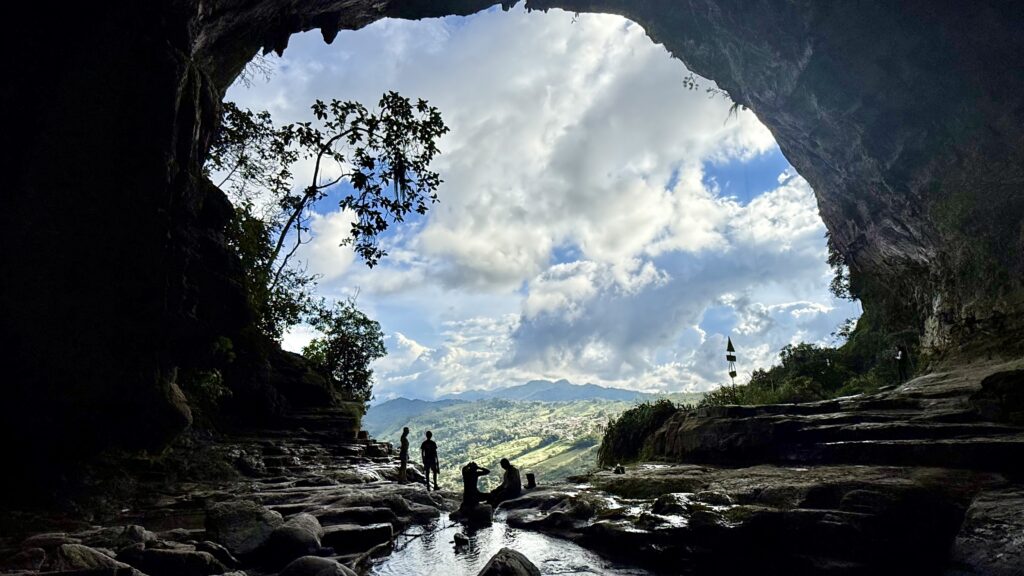
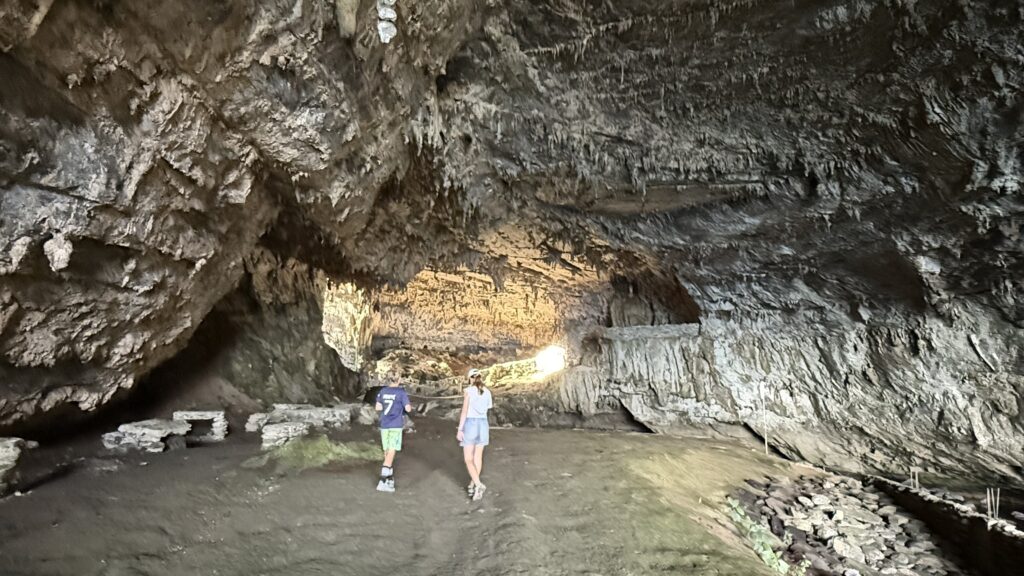
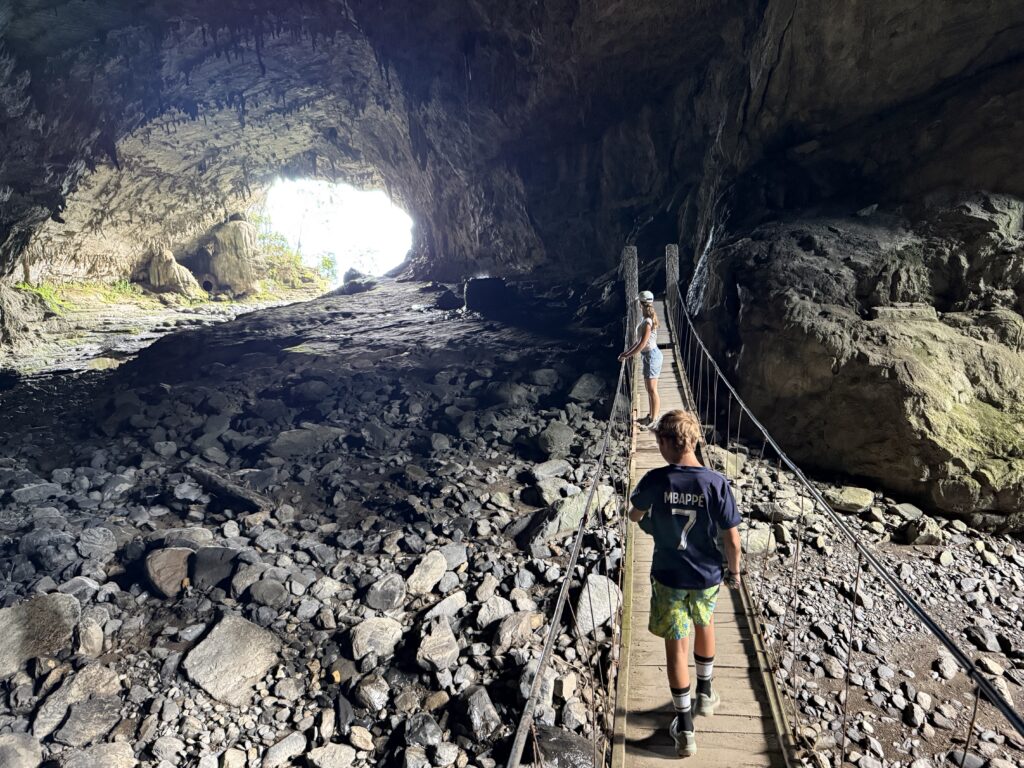
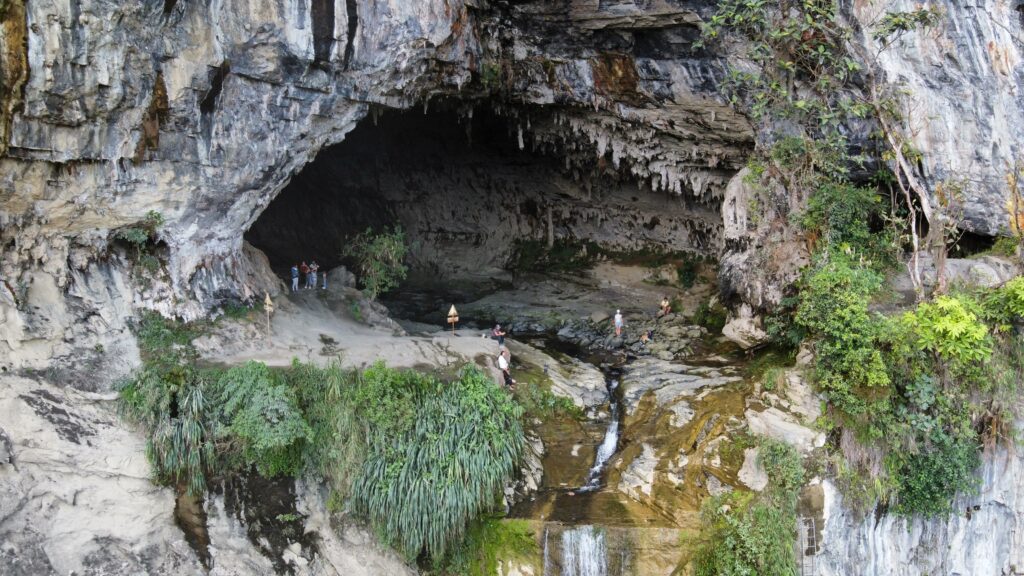
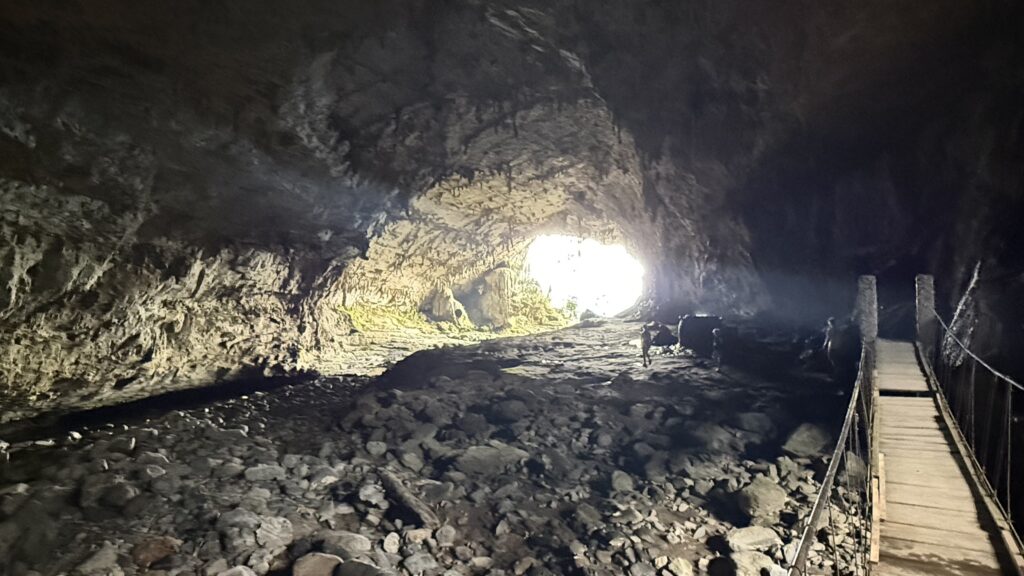
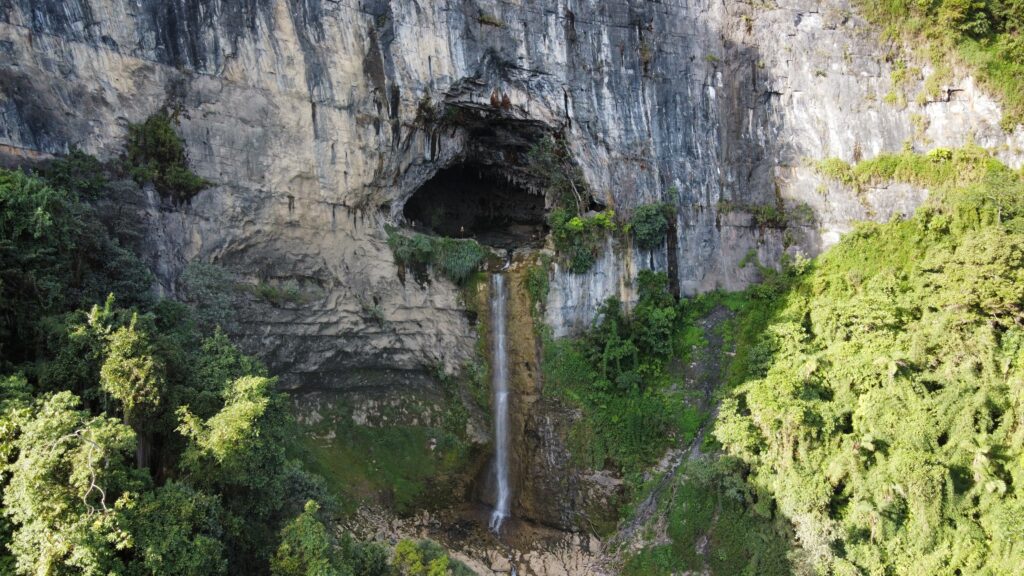
We headed to the isolated village of Florian, where hidden in the hills is one of Colombia’s largest caves, a place with an incredible history stretching back to the days of the Spanish conquistadors. As the Spanish advanced through the region, local Indigenous communities sheltered deep inside the cave, using it not only as a refuge but also as a strategic base from which to launch attacks. This was one of the few regions that resisted Spanish conquest for so long.
Walking through these mountains, it’s impossible not to wonder how the conquistadors ever made it this far. Even today, with a truck, GPS and rough roads, progress is painfully slow. Back then there were no roads at all—just steep jungle-covered mountains, suffocating heat, rivers to cross and vegetation armed with thorns long enough to tear at your clothes and skin.
It must have taken extraordinary determination to push into country like this. Whether driven by the pursuit of gold, power, new territory or the spread of empire, they kept coming. And for the people already living here, the fear of hearing that another expedition was approaching through the jungle must have been unimaginable.
Standing inside the enormous cavern, it was easy to imagine hundreds of people seeking safety within its walls centuries ago. Water levels were low when we visited, but have seen photos of how spectacular the waterfall is during the rainy season.
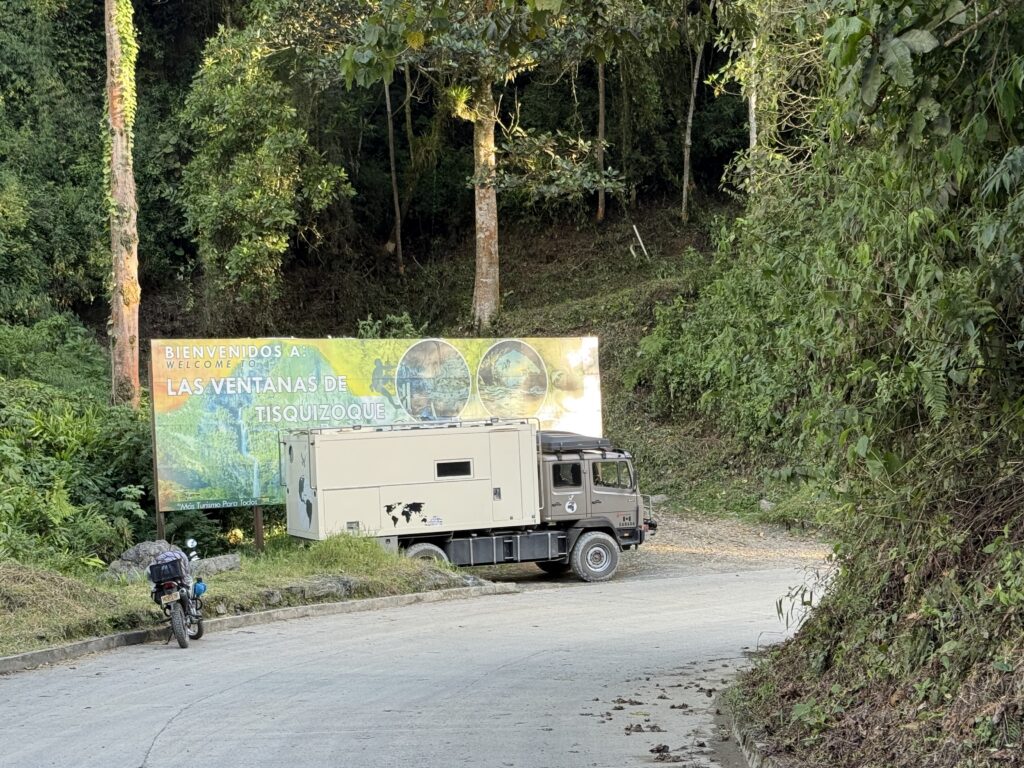
Surprisingly, there was no entrance fee, nobody wanting to capitalize. Easy to miss, it’s marked by just a small break in the brick wall along the roadside. We parked beneath a billboard to hike in, and ended up spending the night there.
We still had a long way to go, and these roads weren’t allowing us to make up any time. Pushing on we had another full day of better, paved, but busier roads to drive before making it back to the lovely colonial town of Barichara.
BARICHARA
Where everything changed.
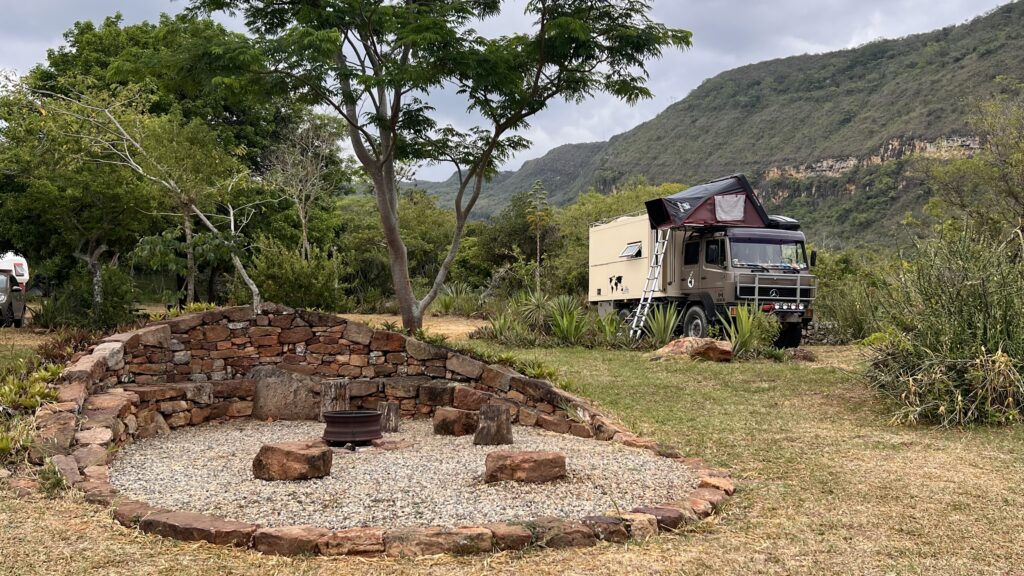
Just as we were looking forward to spending a relaxing day wandering the beautiful colonial streets of Barichara—one of our favourite towns in all of Colombia—and a relaxing day at our equally favourite campground, we received a message from our shipping agent.
Our truck delivery date had been brought forward by two days!
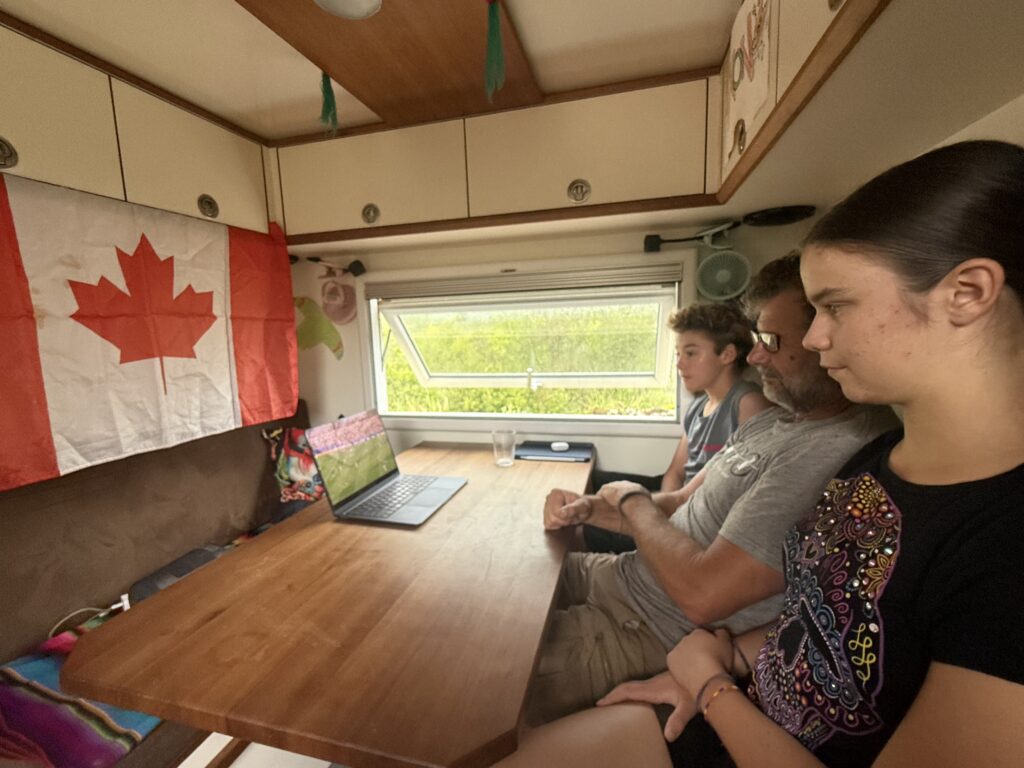
Suddenly sightseeing was replaced with logistics, and watching World Cup Football live stream.
The cupboards had to be emptied, as absolutely no food, is permitted when shipping a vehicle into Mexico. We cooked whatever we could, packed everything else away, gave the truck a thorough clean, and prepared ourselves for the final push to Cartagena.
There were still around 650 kilometres to cover.
We rolled out at 7 a.m. the following morning after saying our farewells to Joop and Julia, the lovely Dutch couple who traded their busy professional lives for a very different one here in Colombia. Fifteen years ago they purchased ten acres of former tobacco farmland and have slowly transformed it into a thriving permaculture oasis, where overlanders from around the world come to rest for a while.
MOMPOX
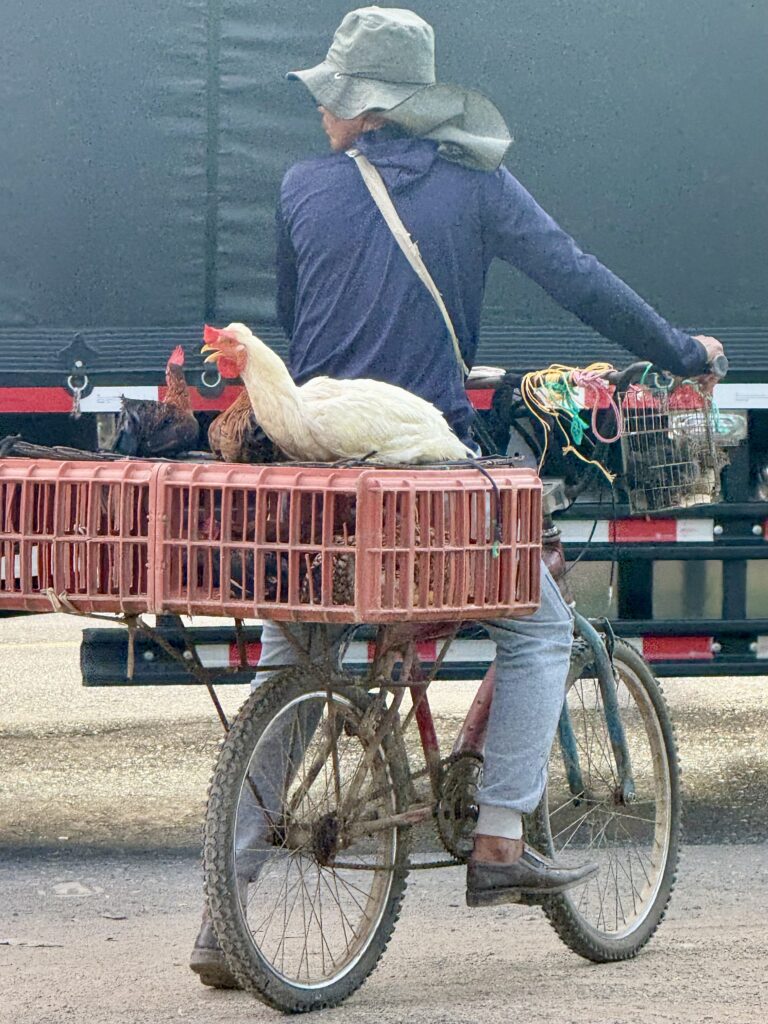
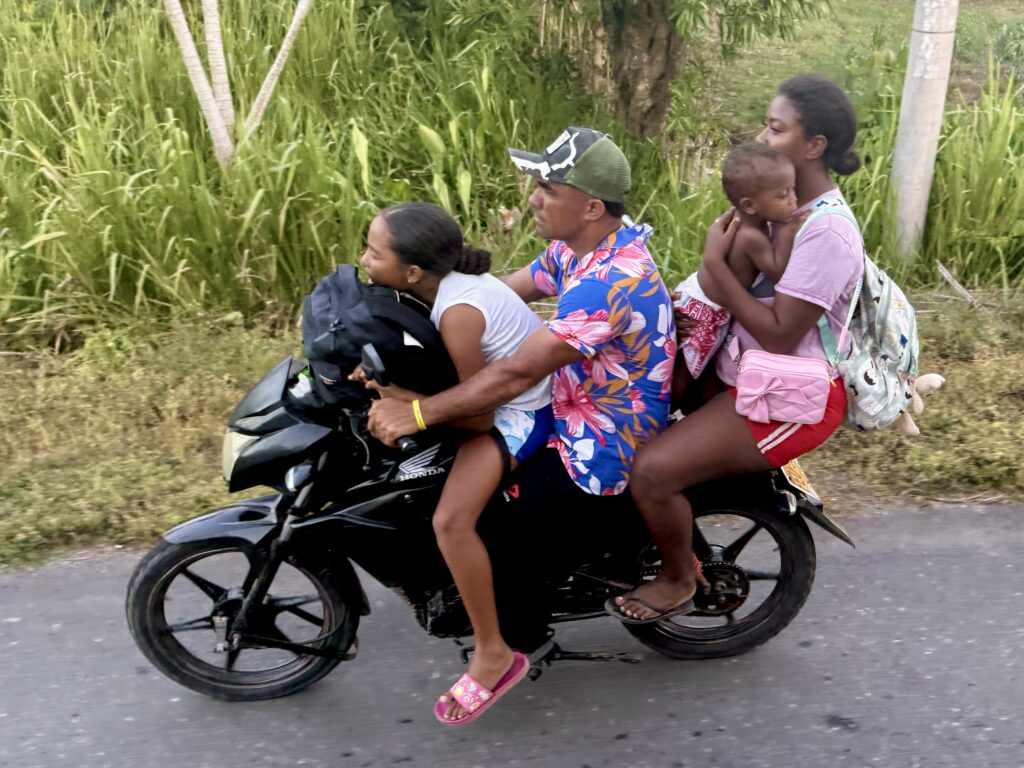
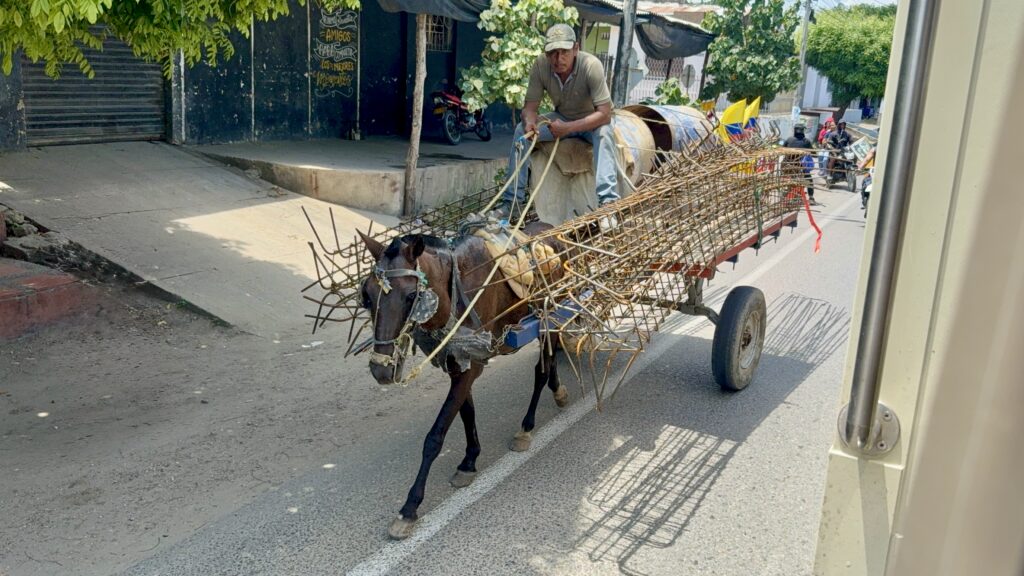
Leaving the highlands for the last time we descended into where we felt to be the hottest and most humid part of Colombia. An exhausting twelve hours later we reached Mompox, arriving after dark, as our previously scouted spot for the night just didn’t feel right. This region is among the poorest we’ve seen, people here have nothing. Kids riding bikes with buckled wheels, no brakes and no shoes. But there is plenty of coke cola for sale everywhere. Donkeys instead of horses, huts instead of houses, you get the picture.
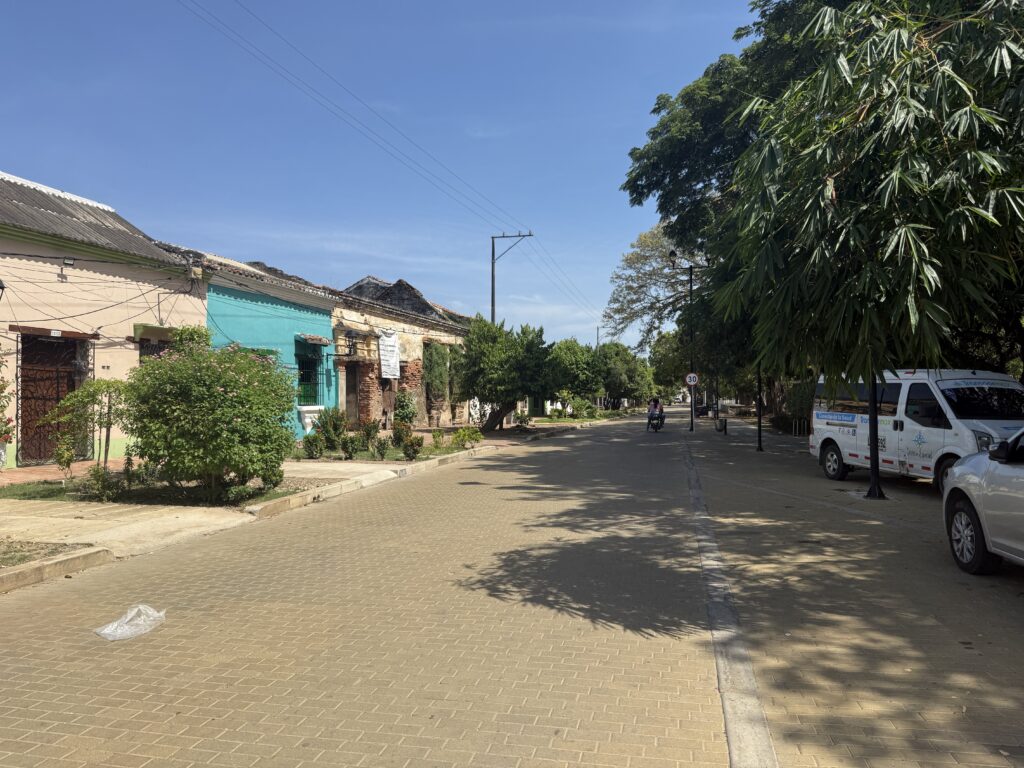
Rolling on another hour or more we reached Mompox, where we had to carefully navigate our way through narrow streets lined with overhanging trees and low-hanging power lines, we suddenly heard a loud bang followed by a woman screaming.
It took us a few more than a few seconds to realize we’d probably snagged one of the overhead wires, oops. Guiltily we didn’t return.
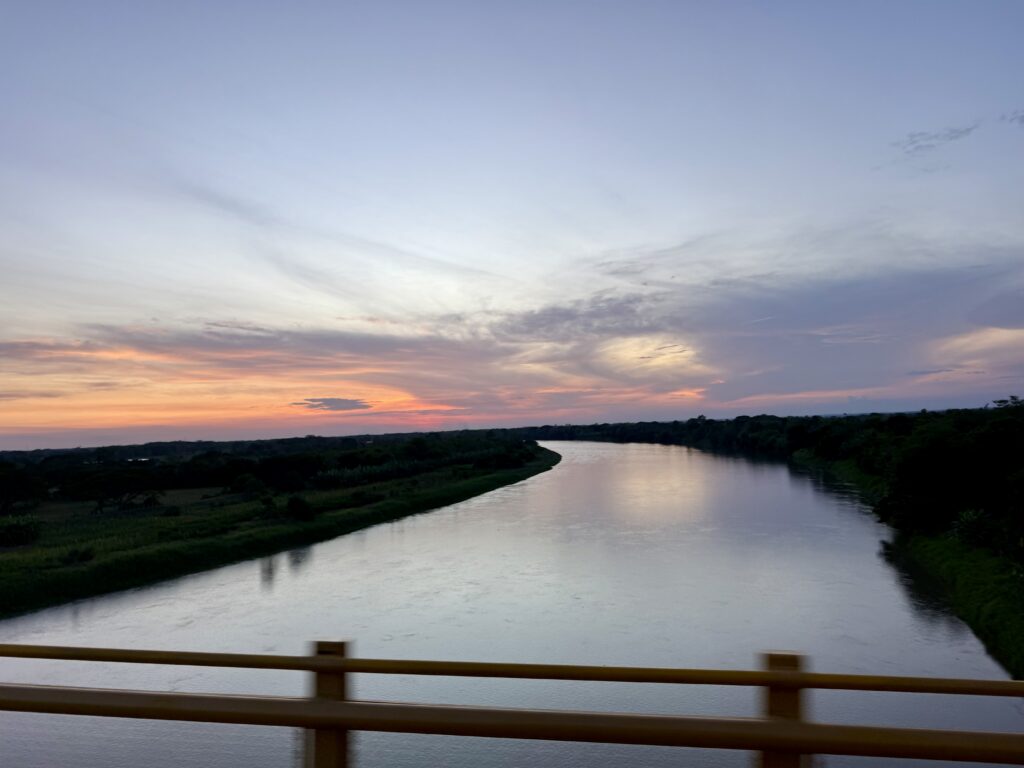
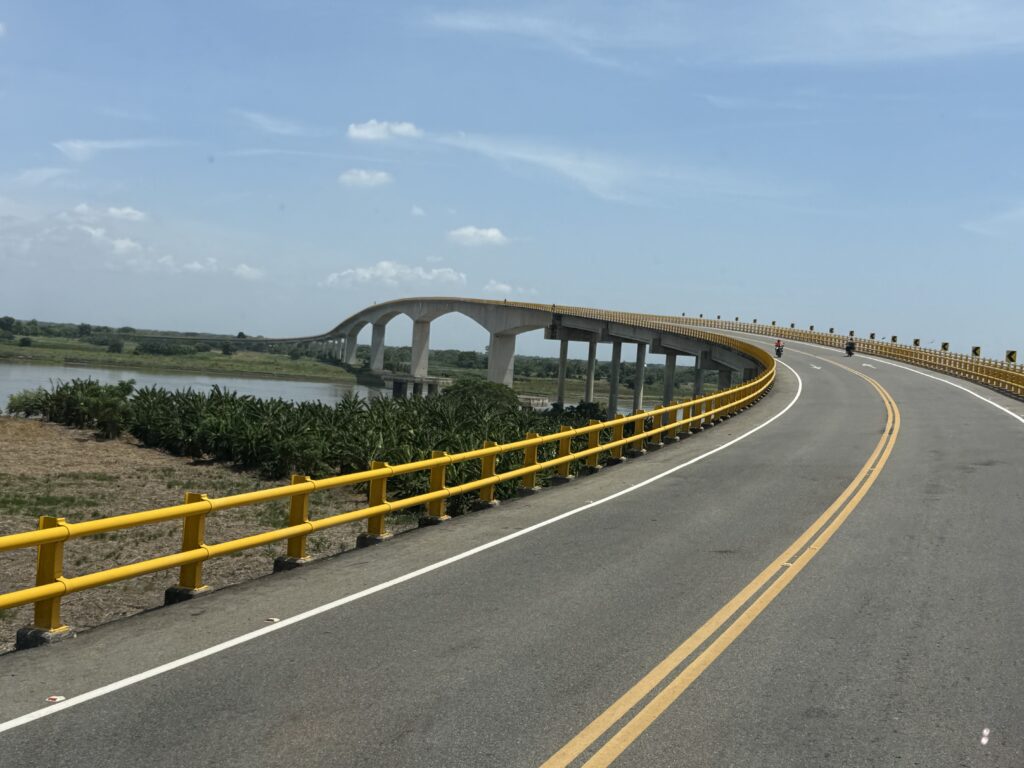
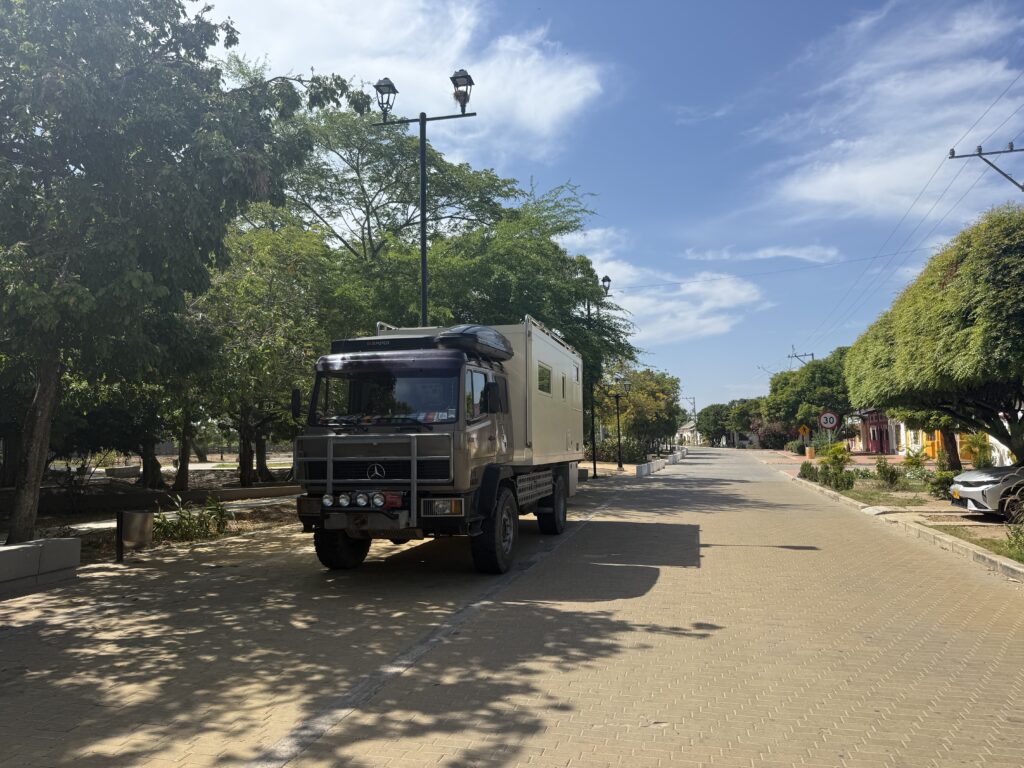
We camped the night in the carpark of the only nice street in town, where others had also camped before us. The riverside malecón stretches along the Magdalena River with shaded walkways and parks, offering a peaceful place to escape the heat. Once a thriving river port, the town gradually declined as centuries of silt changed the course of commerce, leaving behind a beautifully preserved colonial town that’s now quieter.
The heat, however, was relentless.
There wasn’t a breath of wind, and the truck felt like an oven. Thankfully, exhaustion beats discomfort every time, and we were soon asleep beneath our little fans.
ANOTHER ROADBLOCK AND DETOUR
The next morning brought yet another long 12hr driving day.
About three-quarters of the way to Cartagena we came to a complete standstill. Yup, another road blockade, and we never found out why, but did hear that it’s weeks old, you’d think they would have posted a sign at the last intersection, or maybe they did and we missed it not reading Spanish…
By now these had become an all-too-familiar part of travelling.
This was controlled by the police. It’s a toll road and closing point was a toll booth. Vehicles with a pre-paid or auto billed accounts were able to pass. But paying by cash just wasn’t an option, no matter how hard we tried. Our options were to either sit in the blazing sun for five hours waiting for the road to reopen at 7 p.m., or turn around, drive 60 kilometres back, detour around Sincelejo and try another highway, adding another 100km to our day.
Waiting in the heat wasn’t really an option, so back & around we went, adding another 3 hrs driving time which meant we were arriving at camp after closing.
As if that wasn’t enough, passing through another small village to get to our last campground in South America, we caught yet another low-hanging wire. This one cost us about $40 and 45 mins to have repaired.
The locals, however, couldn’t have been more relaxed, they did say with a smile after 30 mins that 350 Colombian pesos will make the problem go away. We negotiated to 140, roughly $35 CAD, then drove on. It was our fault, the end of a long hot day, and compensation was due. How much? who knows, but for us it was the right price.
They seemed far more fascinated by the giant overland truck than they were concerned about the temporary power outage. It wasn’t a problem that couldn’t be fixed—it just took a little time.
By the time we finally rolled into Graham’s campground outside Cartagena it was after 8 p.m., six hours later than we’d expected.
Never has a cool shower felt so good.
The following morning we’d be up early for the final preparations before delivering our home of the past twenty months to the port.
It was hard to believe the South American chapter of our adventure was almost over.
4 Responses
Wow–continue to surprise me that you have the time and concentration to update your blog–Canada the big news West jet on strike –about the worst time of year to have it–In BC many wildfires so when driving lots of highways closed–are you are shipping into Mexico? skipping Central America to make an early return to Whistler? Think diesel might be cheaper in Mexico–
I’ll check some US prices–BC has highest prices anywhere.-Lennox
Well a beautiful spot to be on a sad day. Julie and I are sorry to hear of Mike passing away. I do remember studying the Spaztecs and the Stinkas in school. I will brush up on history. Safe travels home. Xoxo
Well a beautiful spot to be on a sad day. Julie and I are sorry to hear of Mike passing away. Safe travels home. Xoxo
Sorry to hear of your loss.
Glad you are playing catchup on your posts. If not for us readers, to have as a memory for you later in time.